

Nothing ends in life it’s just a beginning to other phases of the journey
Anand Lalchandani
“Funny guy! Are you doing well?”- APJ Abdul Kalam
Know when this statement was been said by our honorable missile man of India
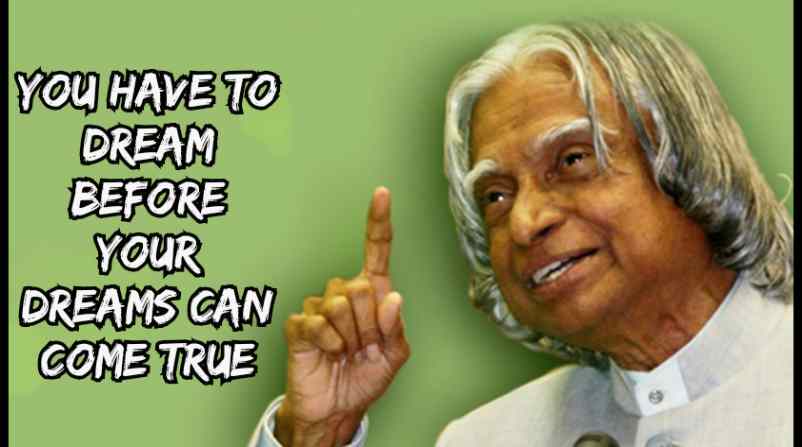
On his death anniversary, let us know about Kalam sir’s success and visionary dream-making come true.
Kalam sir with his life journey made youth, millennial, and other people realized that determination is necessary to achieve any goal in life.
About Kalam
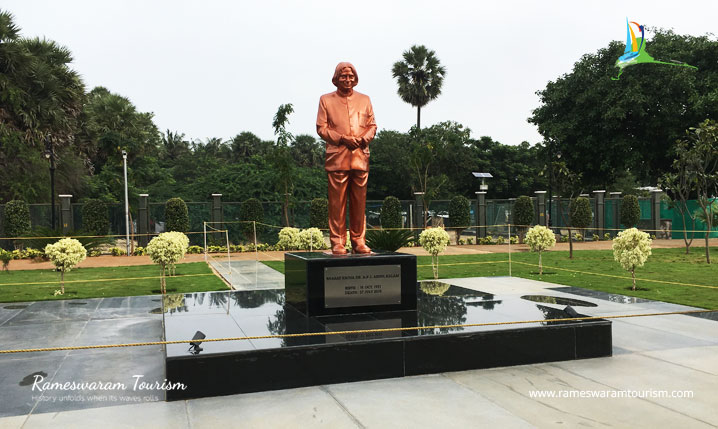
Avul Pakir Jainulabdeen Abdul Kalam (15 October 1931 – 27 July 2015) was an aerospace scientist who served as the 11th President of India from 2002 to 2007.
He was the youngest child in his family and was close to his parents and his brothers and sisters.
He never married and served his relative’s whole life. No doubt he was a very simple person with a simple lifestyle. He was a kind-hearted man, a vegetarian and consumed simple food.
Early Life of Kalam
He was born and raised in Rameswaram, Tamil Nadu and studied physics and aerospace engineering.
Abdul Kalam was the youngest of five siblings, the eldest was a sister, namely Asim Zohra and three elder brothers, namely Mohammed Muthu Meera Lebbai Maraikayar, Mustafa Kalam and Kasim Mohammed. He was close to his family and always helps them, though he remained a bachelor whole life.
He had completed his matriculation from Schwartz Higher Secondary School, Ramanathapuram and later he went to Saint Joseph’s College where he became a physics graduate.
Kalam Success Turn
In 1955, he went to Madras to study aerospace engineering at Madras Institute of Technology.
As a result, Kalam wants to become a fighter pilot but he got 9th position in the qualifiers list and only eight positions were available in the IAF.
Entrance in Aeronautical Development
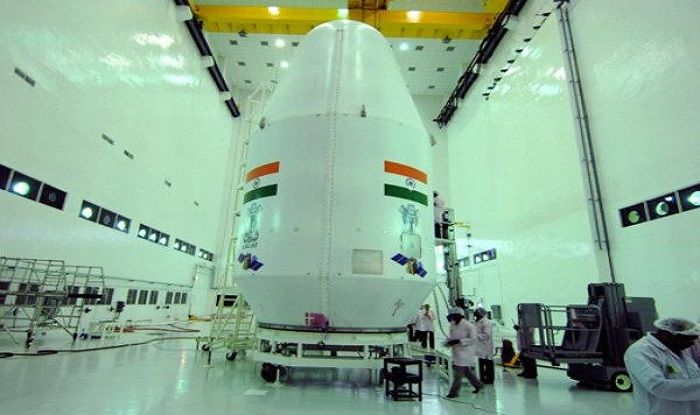
A.P.J Abdul Kalam had completed his graduation in 1957 from the Madras Institute of Technology and in 1958 as a scientist, he had joined the Aeronautical Development Establishment of the Defence Research and Development Organisation (DRDO).
He spent the next four decades as a scientist and science administrator, mainly at the Defence Research and Development Organisation (DRDO) and Indian Space Research Organisation (ISRO) and was intimately involved in India’s civilian space program and military missile development efforts.
He had an important role in the nation’s civilian space program and military missile development. Also, in 1998, he made significant contributions to India’s Pokhran-II nuclear tests.
Success of Kalam
Kalam received the government’s approval in 1969 and expanded the program to include more engineers.
In the 1970s, he had made an effort to develop the Polar Satellite Launch Vehicle (PSLV) to allow India to launch its Indian Remote Sensing (IRS) satellite into Sun-Synchronous orbit, PSLV project was successful and on 20 September 1993, it was first launched.
After the launch of the IRS, Raja Ramanna invited Abdul Kalam to witness the country’s first nuclear test Smiling Buddha as the representative of TBRL.
Kalam known as the Missile Man of India?
In the 1970s, Abdul Kalam directed two projects namely Project Devil and Project Valiant but both were unsuccessful.
After the 2 unsuccessful launches, he did not give up and due to this reason, under the leadership of Abdul Kalam, the project of IGMDP proved to be successful by producing missiles like the first Prithvi missile in 1988 and then the Agni missile in 1989.
Due to this, he was known as “Missile Man of India.”
In 1992, he was appointed as the Scientific Adviser to the Defense Minister. With the rank of a cabinet minister, in 1999, he was appointed as the Principal Scientific Adviser to the Government of India.
Kalam Vision 2020

A.P.J. Abdul Kalam in 1998 proposed a countrywide plan called Technology Vision 2020 to make India a developed nation by the year 2020 and suggested nuclear empowerment, various technological innovations, improvement of agricultural productivity, etc.
Kalam Contribution to Country
A.P.J. Abdul Kalam as a President of India (2002 to 2007)
- In 2002, the National Democratic Alliance (NDA) was in power and nominate Dr. A.P.J. Abdul Kalam for the post of the President of India. Being a popular national figure, he won the presidential election easily.
- He became the 11th President of India by succeeding in K.R Narayanan.
- He received the prestigious Bharat Ratna and became the third President to receive the highest civilian honor after Dr. Sarvapali Radhakrishnan in 1954 Dr. Zakir Hussain in 1963.
- Dr. Abdul Kalam was also known as the People’s President.
- According to Dr. Kalam, the toughest decision taken by him as the President was signing the bill of office of Profit.
- Over his five-year term, he remained committed to his vision of transforming India into a developed nation.
- He decided not to contest the Presidential election again in 2007 and stepped down as the president on 25 July 2007.
Kalam Contribution to Education
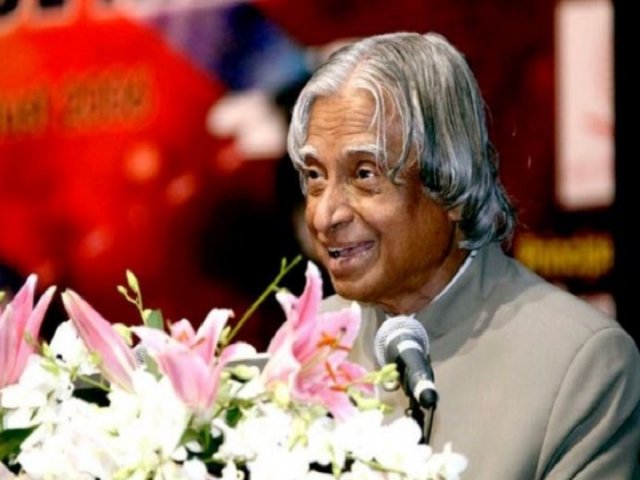
- After leaving the Presidency, Dr. Abdul Kalam chose the academic field and became a visiting professor at
a) the Indian Institute of Management Shillong,
b) the Indian Institute of Management Ahmedabad,
c) the Indian Institute of Management Indore,
d) honorary fellow of the Indian Institute of Science, Bangalore.
- He also served as the chancellor of the Indian Institute of Space Science and Technology Thiruvananthapuram, a professor of Aerospace Engineering at Anna University and an adjunct at many other academic and research institutions across India.
- The information technology was also taught by him at the International Institute of Information Technology, Hyderabad, and technology at Banaras Hindu University and Anna University.
- It is very easy to defeat someone, but it is very hard to win someone.
A.P.J. Abdul Kalam Death
On 27 July 2015, Dr. Abdul Kalam was delivering a lecture at IIM Shillong where he suffered a heart attack and his condition became critical, so, he was shifted to Bethany Hospital where thereafter, he died of cardiac arrest.
Last Wording by Kalam “Funny guy! Are you doing well?”
Awards and Achievements
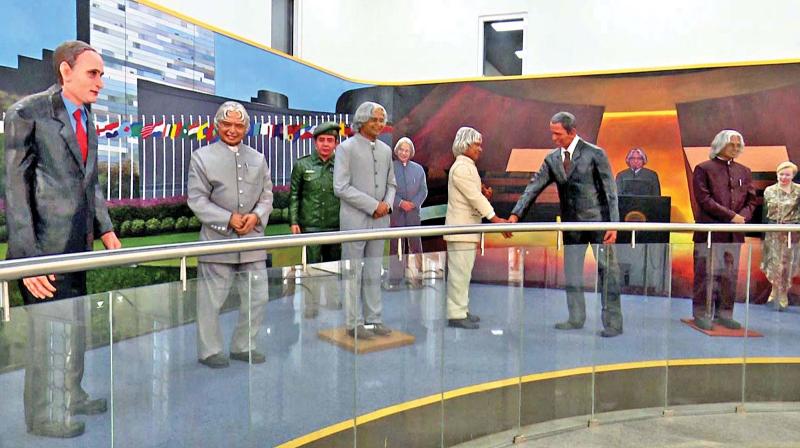
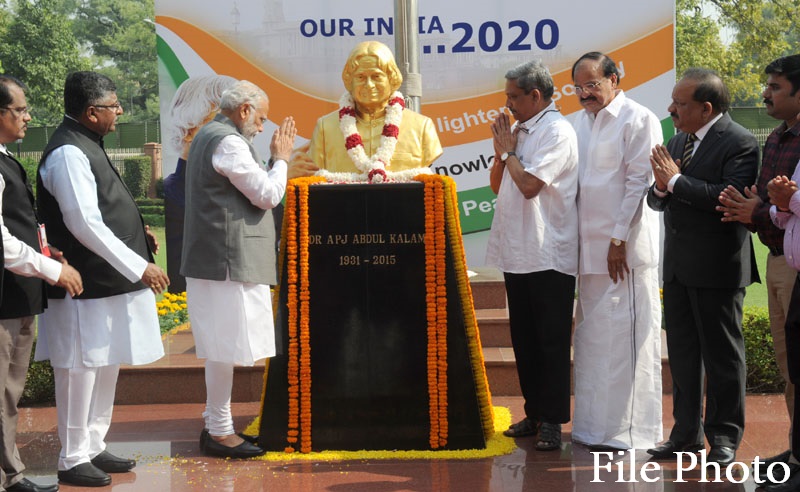
Kalam Sir’s achievement was uncountable. There are only a few listed honors, but apart from it, he not only achieved fame and goodwill with his presence, but also a memorial was built on his name at Pei Karumbu, in the island town of Rameswaram, Tamil Nadu, India. On 27 July 2017, it was inaugurated by the Prime Minister of India, Narendra Modi.
- In 1981, Dr. Kalam received Padma Bhushan from the Government of India.
- In 1990, Dr. Kalam received Padma Vibhushan from the Government of India.
- In 1994 and 1995, Distinguished Fellow and Honorary Fellow by Institute of Directors India and National Academy of Medical Sciences.
- In 1997, he had received Bharat Ratna from the Government of India and Indira Gandhi Award for National Integration from the Indian National Congress.
- In 1998, Veer Savarkar Award from Government of India.
- In 2000, Ramanujan Award from Alwars Research Centre, Chennai.
- In 2007, he was honored with the King Charles II Medal by the Royal Society, U.K. and Doctorate of Science from the University of Wolverhampton, UK.
- In 2008, he won the Hoover Medal given by ASME Foundation, USA and received Doctor of Engineering by Nanyang Technological University, Singapore.
- In 2009, The California Institute of Technology, U.S.A, presented Kalam with the International von Karman Wings Award, Hoover Medal by ASME Foundation, USA and Honorary Doctorate by Oakland University.
- In 2010, Doctor of Engineering by the University of Waterloo.
- In 2011, The IEEE honored Kalam with IEEE Honorary Membership.
- In 2012, Doctor of Laws by Simon Fraser University.
- In 2013, Von Braun Award by the National Space Society.
- In 2014, Doctor of Science by the Edinburgh University, UK.
He not only famed with his high success in India but also internationally, due to which he has still remembered in people’s hearts all wide the globe.
Know about the quotes that state the value on APJ Abdul Kalam: Click Here
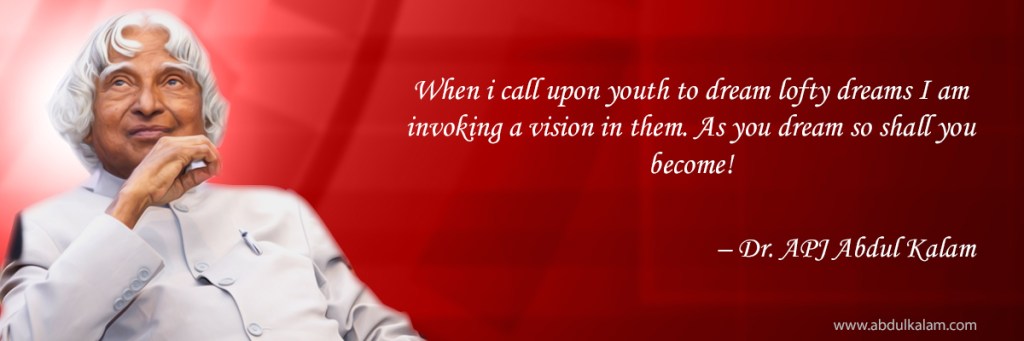
Get the motivational quotes and pictures by APJ Abdul Kalam: Click here
 Anand Blog